
Separate Orange County Assessment Figures from Sale Evidence
Start with the Orange County parcel record itself. It may list several figures side by side. These include a land assessment, a total assessment, and Full Market Value. A deed may state one consideration, yet a later market sale supports a different price. None of these numbers substitutes for another. New York's equalization rate describes how a whole municipality's assessed value relates to market value. It is not a parcel appraisal. Ranking two cities by raw assessment also ignores their different levels of assessment.
Date every comparison you make. Record the assessment year and the property class. Note the land and total assessment, Full Market Value, and exemptions. Include the municipal equalization context. Add the date and nature of any sale. Some sales should not be treated as comparables at all. A family transaction can distort the picture, and so can a partial-interest transfer. So can a distress sale, or property improved after transfer. Permit and planning history explains a change only after completion. The updated assessment roll must be confirmed too.
The New York State equalization-rate guide lays out the formula and its terms.
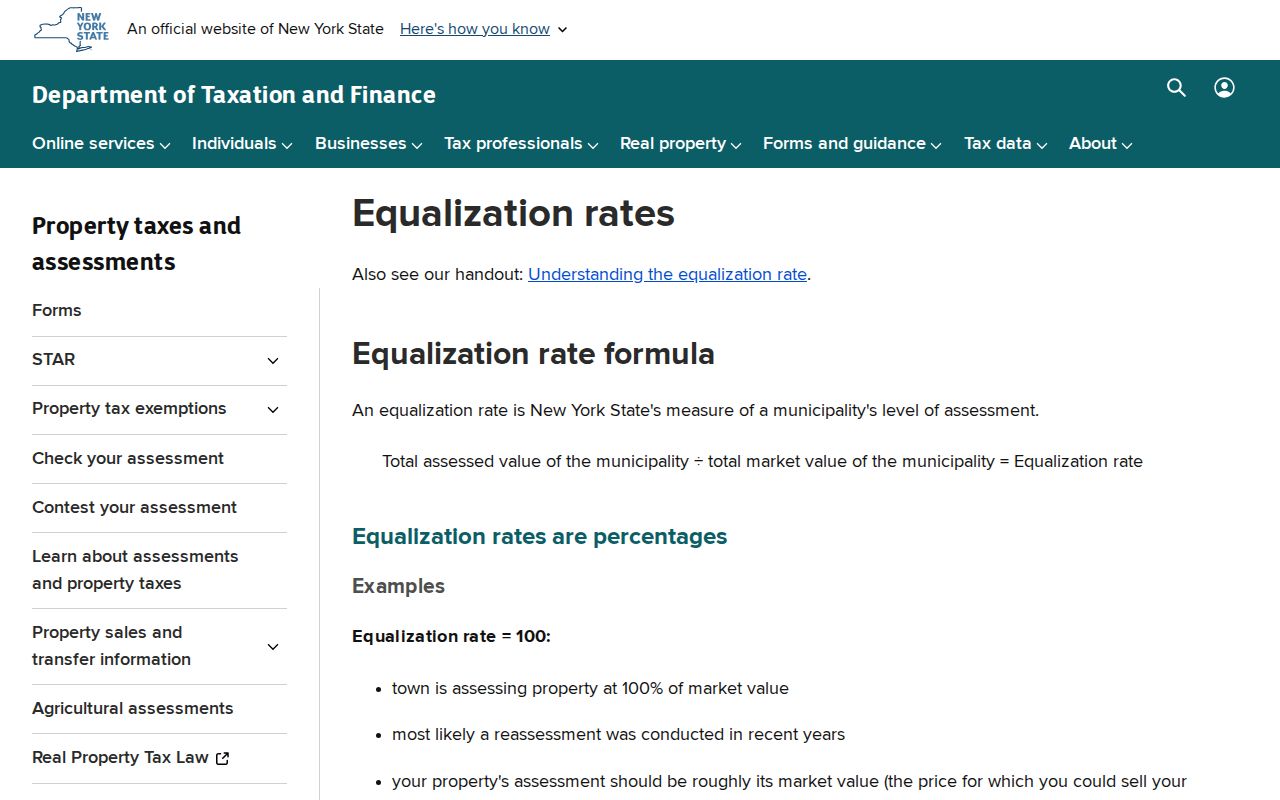
The formula shows why an assessment estimate is not a sale price and not an independent appraisal. It measures a relationship, not a property.
Read the Orange County Value Fields Separately
Each field on a parcel record has a job. The land assessment covers the ground. The total assessment is the taxable starting point the local assessor sets before exemptions come off. Full Market Value is an estimate produced inside that same assessment system. A deed's consideration is simply a recorded transaction figure, and it may not reflect an arm's-length sale. Keep each number with its own date.
| Value Type | Meaning | Record Source |
|---|---|---|
| Land assessment | The assessed component assigned to land | Dated parcel card or roll |
| Total assessment | Local assessed amount before applicable exemptions | Assessment roll |
| Full Market Value | Assessment-system market estimate | Parcel record with municipal ratio context |
| Recorded consideration | Amount stated for a particular transfer | Deed and transfer forms |
| Taxable amount | Assessment after relevant exemption treatment | Roll and tax bill |
Call none of these an appraisal. A sale may involve family, a partial interest, distress, multiple parcels, or later improvements. Name the field exactly. Keep its date beside the number.
Look Up an Orange County Assessed Value
Beacon searches by address, owner, tax-map number, or municipality. Confirm the situs and municipality first. Then save the SBL, property class, assessment year, land and total assessment, Full Market Value, exemptions, deed reference, and the visible data date. County material notes the public interface also offers tax maps, photos, comparable searches, and report-writer tools.
- Normalize the address and select the legal municipality rather than relying on ZIP.
- Verify the parcel identifiers and property class before copying any value.
- Record the assessment year, each value label, exemptions, and portal date.
- Check a recorded sale in IQS when transaction evidence is relevant.
The legacy Image Mate page points to Beacon and notes weekly assessment updates, except for Warwick and Newburgh. Preserve that limitation in current comparisons. A portal migration can move a field without deleting the underlying data.
Use New York Equalization Rates with Care
An equalization rate measures one thing. It shows how a municipality's total assessed value relates to its market value. That ratio lets counties allocate taxes fairly where towns assess at different percentages. It is not a parcel appraisal. Two Orange County cities can show very different assessment-to-market relationships. The reason is simple: their local levels of assessment differ.
A dated comparison should carry the parcel's assessment year and values. It should also list the municipality with its applicable rate or level, and any recorded sale date. Mixing a current assessment with an older sale breaks the math. Borrowing a rate from another municipality does too. If the goal is an assessment challenge, keep the tentative roll and the property inventory. Also keep comparable leads and the local filing calendar. A simple ratio alone is not conclusive proof of anything.
Note: Use equalization rates for municipal-level work, never as a parcel appraisal.
Permits and Planning Can Explain a Value Change
Municipal records often explain a value jump before the tax bill does. Some actions leave a dated trail. Examples include a planned addition, a subdivision, a lot-line change, or a rehabilitation. A certificate of occupancy does too. Newburgh architectural review, Middletown planning material, and Port Jervis building files can supply that timeline. Approval alone does not prove construction happened. A permit applicant may not be the owner of record either. Confirm final inspection or completion, then check whether the assessment inventory changed.
Assessments also move without any sale. Improvements can shift the number. So can a municipal reassessment, an inventory correction, an exemption change, or a parcel split. A tax bill can change because rates and levies change. Keep those causes separate from market-price claims. Formal challenge routes include RP-524 and Grievance Day. Small Claims Assessment Review is another option. New York guidance describes these and other review routes. The tax-record page covers that process in detail.
The Values on a Orange County Property Record
| Value | What It Is | Where |
|---|
Looking Up a Orange County Property Value
- Assessed value
- Market / appraised value
- Level of assessment
What a Orange County Assessor Value Is Not
Value vs price.
Create a Dated Orange County Value Comparison
Build the comparison year by year. Record the land assessment, total assessment, Full Market Value, exemptions, property class, municipality, and assessment-ratio context for each. Add a sale only with its deed date, consideration, reference, parcel coverage, and notes on relationship, distress, partial interest, or later improvements.
Compare like with like throughout. A city bill total is not a county assessment. Full Market Value is not an appraisal. When a permit or subdivision matters, document the approval, the completion, and the first later roll reflecting the change. The resulting timeline explains a shift without claiming causation the records themselves do not establish.
State the Limits of an Orange County Value Finding
A portal value is a dated assessment field, not a promise of sale price. Market conditions, property condition, unrecorded work, partial interests, and transaction terms may never reach the public record. For lending, litigation, or a purchase decision, get the appropriate appraisal or professional advice. Use the county record as supporting evidence.