
Middletown Property Records Follow City SBL Fields
Two governments split the work. Orange County keeps assessment data, GIS mapping, and every recorded deed, while the City of Middletown holds planning, zoning, building, and city-tax material for parcels inside its boundary. Begin with the county parcel identity. Then carry the Section-Block-Lot value straight into the city records that need it. Postal ZIP Codes 10940 and 10941 are only delivery hints, never proof that an address sits inside the city limits.
The city Planning Board application asks for a property address, SBL, zoning, owner, applicant, and project details. Keep those roles distinct. An applicant or permit holder is often not the recorded grantee. The Stub Street Subdivision and its lot-line changes trace the full sequence, from city review to a filed County Clerk map, then on to new parcel identifiers and later deeds. A proposed lot should not be treated as an active tax parcel until assessment, GIS, or deed evidence confirms it.
Middletown Tax Bills Use Their Own City Route
City tax bills travel their own route here. The BAS school-tax system covers these searches. The mytaxbill interface does too. Both let you search Middletown by bill number, tax map, address, owner, property, or bill type. Save the year and the levy you picked along with each result. Remember what a bill proves and what it does not. It names a taxpayer and a billing status. But it decides nothing about ownership. So compare the SBL in Beacon and read the latest deed before drawing any title conclusion. The Middletown city tax portal lays out the search choices.
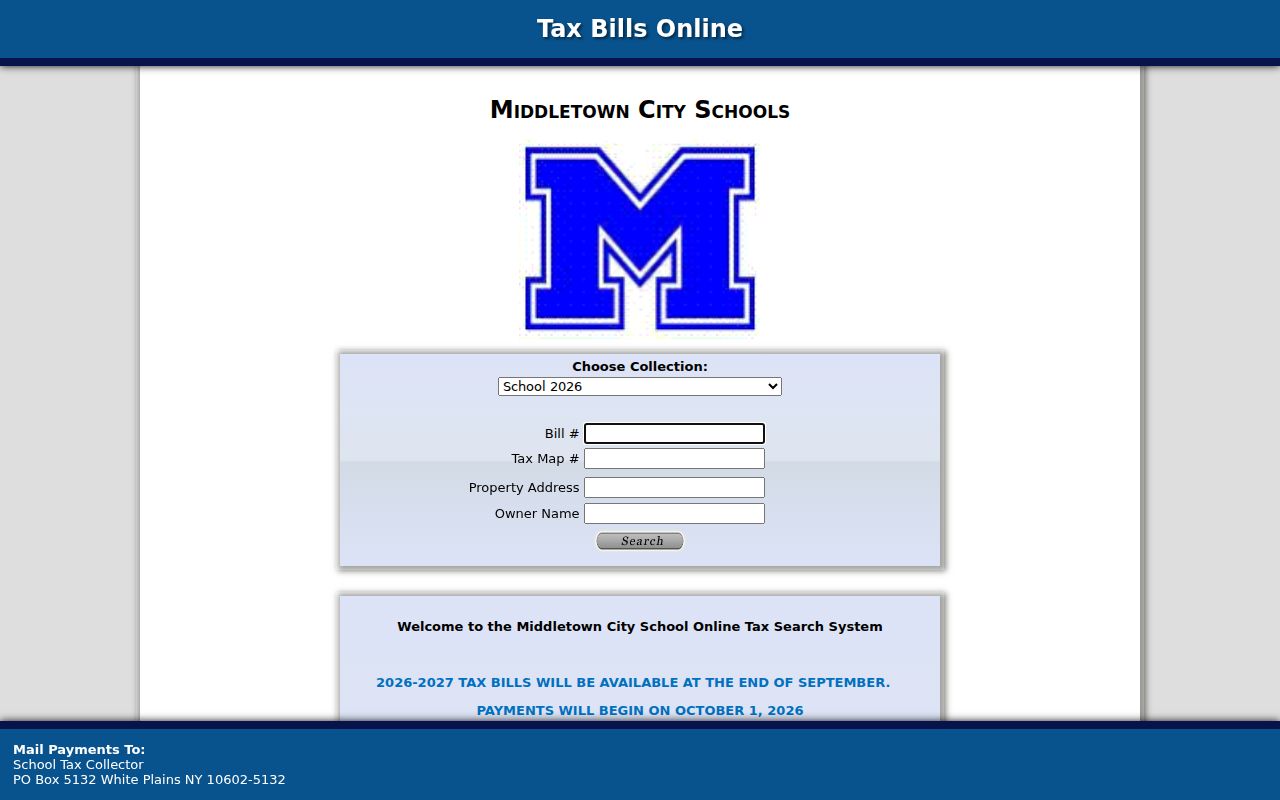
The official portal page makes the city tax path easy to tell apart from Orange County's broader parcel search.
Search Middletown Property Records in Five Steps
Open Orange County Beacon and search by address, selecting Middletown as the municipality. Write down the SBL right away. Save the assessment owner and mailing field. Also record the values, the deed reference, and the portal date. Check the same parcel in GIS. Confirm its polygon and municipal setting. Then open the latest deed in IQS. Finish with the city tax portal and whichever city planning or building office applies.
- Confirm municipality and SBL in Beacon.
- Check the parcel shape and adjoining geography in GIS.
- Read the newest matching deed in IQS.
- Search the correct Middletown tax bill type and year.
- Request city permits or planning files by address and SBL.
That order keeps assessment owner, recorded grantee, taxpayer, applicant, and permit holder in their separate lanes.
Where Middletown Property Records Are Kept
The Orange County Clerk in Goshen is the recording office for deeds, mortgages, maps, liens, and related instruments. Orange County Real Property and Beacon handle assessment access. County GIS supplies the parcel mapping. Middletown itself maintains the municipal tax, planning, public works, building, code, and zoning records tied to city administration.
No separate city recorder exists. When a city application cites a map or a transfer, go back to the County Clerk for the recorded instrument. A city file may list only a mailing address. Verify its SBL before assuming the project covers the parcel you are tracking.
Middletown Planning Fields Connect Projects to Parcels
A Planning Board application captures a property address, Section-Block-Lot, zoning, owner, applicant, and project details. Save every field, plus the meeting or decision date. Note who signed what. An applicant may be an architect, a contract purchaser, a developer, or an agent rather than the recorded owner, so never read the application as proof of title.
| City Field | Use | County Check |
|---|---|---|
| Address and SBL | Identify the subject site | Beacon and GIS |
| Owner and applicant | Keep legal and filing roles separate | Latest IQS deed |
| Zoning | Describe city land-use setting | Dated zoning source |
| Project or map | Follow the proposal | Filed County Clerk map |
Stub Street Shows the Middletown Subdivision Trail
Stub Street is a textbook case of how parcel identity forms. Start with the city application and its decision. Locate the filed map at the County Clerk's office. Identify the parent parcel and the proposed lots. Then check Beacon and GIS for later SBL entries. Compare the deeds recorded before and after the map.
A planning approval alone creates no assessed parcel. A proposed lot proves no later conveyance. Cite the first dated county source that recognizes each new identity, and stop there.
Middletown Tax Records Need Bill Context
The Middletown BAS and mytaxbill resources support searches by bill number and tax map. They also search by address, owner, property, and bill type. Record the year, the levy, and the bill number. Note the taxpayer label, the due date, any penalty, and the payment status too. Match every result to the SBL rather than to a name alone.
STAR or other exemptions can shift taxable amounts without touching title. A paid bill establishes no ownership either. Pull the dated owner field from the assessment roll. Then look to the deed for recorded vesting.
Middletown Addresses, Values, and Record Limits
A ZIP mismatch can sink a city search. Before concluding that no record exists, compare the postal ZIP and the municipality. Then check the school district, the GIS address point, and the SBL. Values need their labels too, because land assessment, total assessment, Full Market Value, taxable amount, and recorded consideration measure different things.
Middletown property records support research, not conclusions. They are not a title opinion, an appraisal, or a survey. Preserve source dates. Note any missing image or permit response, and call a licensed surveyor or title professional when the question demands legal certainty.
How to Search Middletown Property Records
Where Middletown Property Records Are Kept
Middletown Neighborhoods and Subdivisions in the Records
| Neighborhood / Subdivision | Era | In the Records |
|---|
What Middletown Property Records Show and Their Limits
Lawful use.
Middletown Historic Address Research
City directories and newspapers can pin a dated resident or business to an address. They cannot establish a property role. That role needs a County Clerk deed, a probate file, or a historic tax source. Search name variants and street renumbering. Then link the old legal description to a modern SBL through filed maps. Adjoining-owner calls help too. Until the legal chain supports more, label any directory hit as an address association.
For a complete Middletown file, save the city planning or permit event. Add the county deed or map, the assessment date, and the relevant city tax year. That timeline keeps proposal, recording, construction, and taxation separate. Nothing blurs them into one event.
Request Missing Middletown Building Records
Middletown keeps more building paper than any portal shows. When the online planning record runs thin, ask the city directly for permit applications, approved plans, inspection logs, certificates of occupancy, violation notices, demolition permits, and final sign-offs. Include the street address, the SBL, any known owner or applicant, and a narrow date range. Request electronic copies. Ask for partial production too, since even a few pages can settle a question.
A no-record reply is an access result, not proof that the work never happened. Set it beside Planning Board minutes, County Clerk maps, deeds, and any later assessment inventory. Keep each date and each role distinct.
Before closing the file, confirm the city still holds jurisdiction over the parcel and that the tax bill type you selected is the right one. Middletown geography can mislead. Mailing addresses, school districts, and municipal boundaries do not always agree.
Good Middletown research also tracks the meeting date and status of each application. A submission, a workshop, an approval, a filed map, an issued permit, a completed inspection, an assessment update, and a later tax bill are all separate milestones. Lined up by date, they show which parts of a project became official. But some stayed on paper as proposals. When a portal is missing an older item, note the city's response. Then pursue the next County Clerk or archive reference worth checking. That trail is the real record.